從統計學上說,飛機是最安全的運輸工具,在遇到氣流或緊急著陸時,飛機座椅的安全帶理論上可以提供保護。但是帶小孩旅行的家長應該注意,兩歲以下的兒童沒有自己的座位,兒童坐在父母的膝蓋上沒有任何安全保護。兩歲至七歲的兒童,雖然有自己的座位,但飛機座椅的安全帶為成人設計,無法為孩子們提供全面保護。最合適的辦法是使用經過認證貼有"可供機上使用 For Use in Aircraft”標識的兒童汽車安全座椅。
The Hong Kong Consumer Council has just published a report on child car seat testing, and found that the safety performance of the samples tested was very different. The Council thus reminds parents to choose carefully. The people of Hong Kong people are renowned for traveling. Have you ever thought about bringing a child seat on a plane for a young child to use?
Statistically speaking, the aircraft is the safest means of transport, and the seatbelts used for aircraft seats can theoretically provide effective protection when air turbulence or an emergency landing is encountered. However, parents with children should be aware that children under the age of two do not have their own seats, and that children do not have any security protection when sitting on a parent’s knees. Children between the ages of two and seven have their own seats, but the seatbelts used for aircraft seats are designed for adults, and do not provide comprehensive protection for children. The most appropriate method is to use a child car seat certified with the label “For Use in Aircraft.”
TÜV Rheinland has been a test service provider since 2003, and offers this child seat certification service, which indicates that the seat can be easily and safely fastened using a seatbelt on an aircraft.
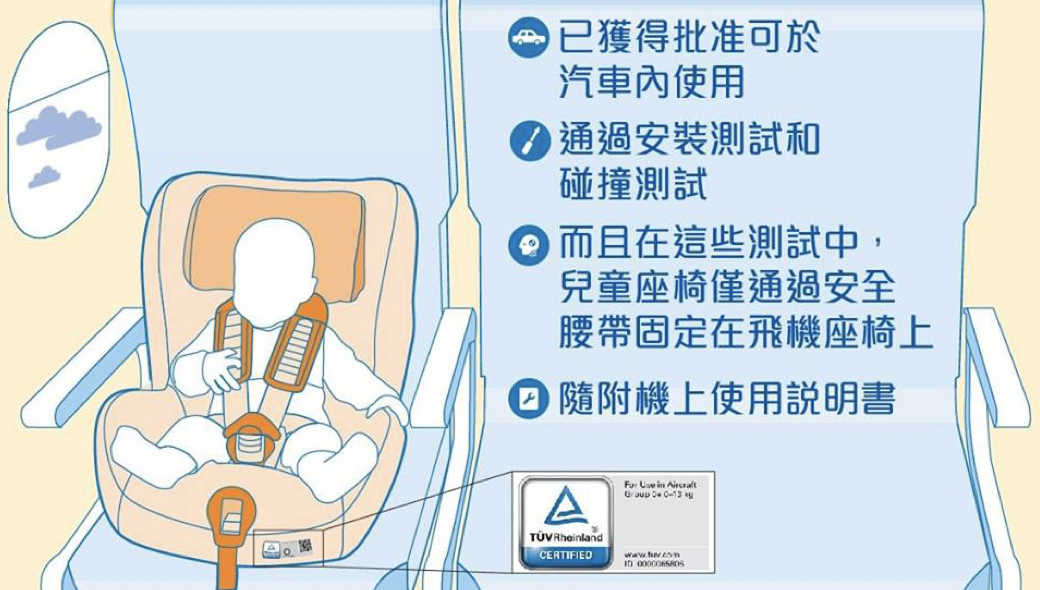
To obtain “For Use in Aircraft” certification, a child seat must:
Be approved for use in car
Pass installation testing and crash testing
In addition, as part of this testing the child seat is only secured to an aircraft seat using a seatbelt
An on-board instruction manual must be included
TÜV Rheinland lists currently certified child seats, and some of the children’s seats tested by the Consumer Council are also listed on this page.
TÜV Rheinland reminds those intending to use a child care seat on an air flight to contact the airline beforehand to confirm that the aircraft on the flight is suitable and the seat can be used before booking the seat. Hong Kong has airlines that list aircraft models suitable for use with safety seats, which you can view before use.
日前,俄羅斯聯邦認證服務部門發佈了2019年上半年度稽核報告。在2019年上半年完成的2654項公開的市場稽核活動中,641家認證機構和實驗室接受審核,其中586家在審核後被停權,3105張CoC (Certificate
of Compliance,符合性認證證書) 以及37791張DoC (Declaration of Conformity,符合性聲明) 被取消。
NIAS Testing: Protecting Food Safety for Consumers
Food safety is an important issue for all global consumers. There are many steps involved in ensuring food safety and protecting the health of consumers. The quality and safety of food contact materials (FCM) have now become a hot topic in related industries so taking pro-active measures to reduce and control the transfer of non-intentionally added substances (NIAS) in FCM will become a top priority.
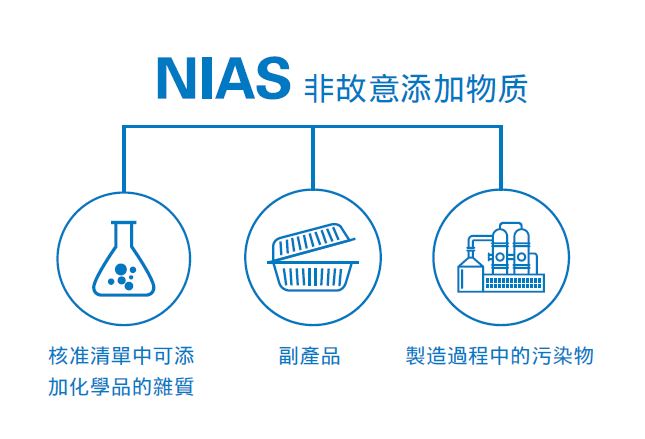
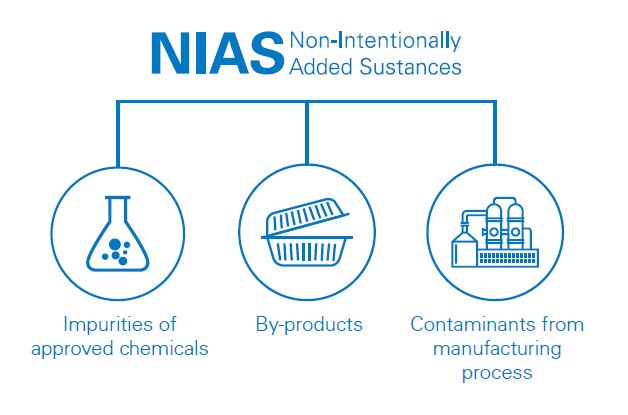
NIAS refers to substances that are unintentionally present in FCM. These substances can come from different sources such as impurities in the raw materials, by-products of chemical reactions and contaminants during the production process. There is usually no control over the presence of NIAS. It can be a wide range of chemical substance. If no assessment and corrective actions are undertaken of the final FCM then food may be contaminated with these harmful substances and pose a threat to consumer health.
National governments monitor and regulate the quality and safety of FCM to different degrees. Conformity assessments for FCM currently include the selection of appropriate materials. Continuous improvements in updates of FCM regulations around the world however mean that businesses in related industries will face increasingly complex regulatory requirements and even stricter trade barriers. For example, Article 3 of Regulation (EC) 1935/2004 requires materials and articles coming into contact with food must not transfer their constituents to food in quantities which could endanger human health. NIAS testing can be one of the solutions for checking the potentially hazardous chemicals migrating from FCM.
There is currently insufficient safety awareness among Chinese enterprises on FCM. In the first half of 2019, the EU Rapid Alert System for Food and Feed (RASFF) issued 76 FCM alerts, an increase of 27% over the same period last year. 84% of these FCM alerts was exported from China. We can therefore expect the continued tightening of regulatory requirements and authorities will also become increasingly aware of advanced requirements such as NIAS testing. The inclusion of NIAS testing in product conformity assessments by businesses is therefore strongly recommended to prepare for the future.
Please note that there is currently no official standards for NIAS testing. Not all substances can be tested by a single laboratory method either. To help the industry understand the topic of NIAS, TÜV Rheinland will share the latest developments, practical tools for food contact materials regulations in the near future.
As a leading international service provider of testing, inspection and certification, TÜV Rheinland can provide one-stop services for different types of FCM services. These include customized testing plans for international buyers, providing technical support for customer consultations, extensive food contact testing for all materials, hosting of symposiums and training workshops, and regular updates on product regulations. TÜV Rheinland’s team of technical experts in Hong Kong stays in close contact with regulators around the world to help businesses in related industries satisfy regulatory and voluntary requirements, as well as provide consumers with safe, high-quality products.
You can also contact TÜV Rheinland to learn more about NIAS testing. We will be more than happy to provide you with our advice and assistance on how to improve the safety of products on the market and protect the health of consumers.
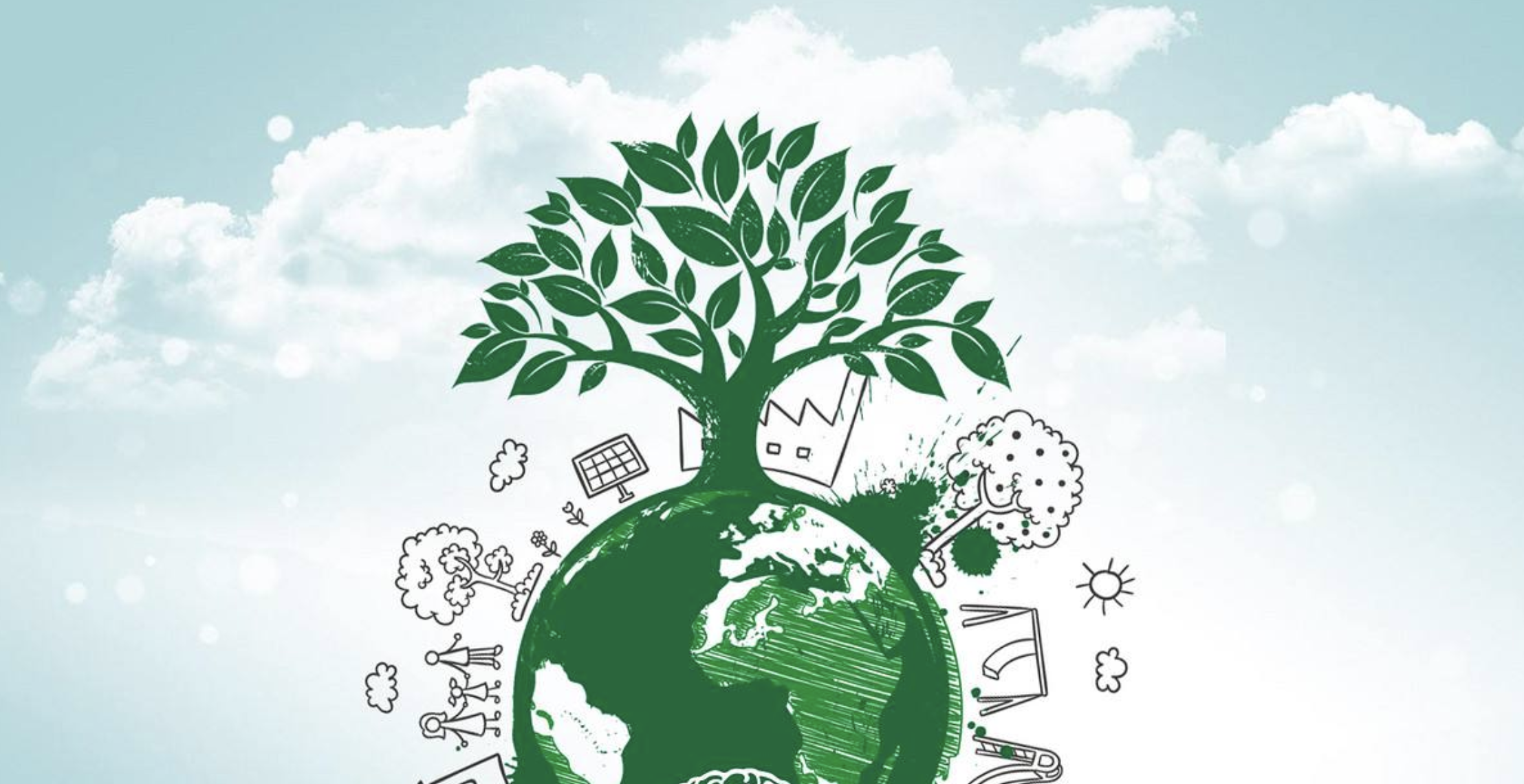
The Paris Agreement of the United Nations Framework Convention on Climate Change is a landmark achievement, in that the global community has agreed to reduce climate-related risks and to secure sustainable development. The Hong Kong Government released Hong Kong’s Climate Action Plan 2030+ in 2017, setting out in detail the key measures to be taken, as well as the targets.
Reducing emissions of carbon dioxide and other greenhouse gases (GHGs) can combat the climate change and protect the environment. For a company, commercial and industrial operations may cause considerable GHG emissions. In order to manage carbon emissions, the company has to measure and calculate these emissions, and set a carbon reduction target. Reduction target(s) are key for facilitating and operationalizing businesses’ decarbonisation.
Benefits of implementing Corporate Carbon Management
Implementation of Corporate Carbon Management raises an enterprise’s energy-efficiency standard to the best-practice level and lower operating costs. Nowadays, brands and consumers across the world pay close attention to environmental protection, and control of carbon emissions is one of the most important measures in showing commitment to society and attracting new clients. Companies that control carbon emissions with verification can benchmark themselves against other global competitors, and stand out amongst these competitors.
Carbon footprint schemes in Hong Kong
In Hong Kong, several carbon footprint schemes have been initiated with the aim of rallying the local business sector to capture opportunities in carbon reduction. They also aim to encourage and to sustain concerted industry effort on carbon audits and reduction that will help shape a low-carbon future for Hong Kong.
ISO 14064 standard for climate change
This series of standards was launched in 2002 with identification of the need for harmonization of diverse GHG programs proliferating at the international, national, regional, and local levels. The development process included over 11 international negotiation meetings and the efforts of 175 experts representing over 45 countries. ISO 14064 Part 1 (Corporate level) and ISO 14064 Part 2 (Project Level) are used to develop documentation and reports called “GHG assertions.” A “validation” or “verification” body (which meets the requirements of ISO 14065, e.g. TÜV Rheinland) can use the process outlined in ISO 14064 Part 3 to audit these GHG assertions as a third party.
WWF Low Carbon Office Operation Programme (LOOP)
WWF LOOP was established in 2010 to enable Hong Kong companies and organisations to become part of the solution to climate change. Companies or organisations engage with a group of like-minded forward-looking leaders to reduce their greenhouse gas emissions generated from office operation via the adoption of managerial and technological best practices, staff behavioural adaptation, and a labelling scheme. LOOP companies and organisations can access a tool-kit that allows measurement and analysis of the carbon performance of an office, formulation of an emissions reduction strategy, and reporting on their improved carbon performance. Quantitative data verification (GHG Easy) and Qualitative staff behaviour assessment (Assessment checklist) are conducted on the implementation of low-carbon practices and compliance with the WWF LOOP labelling scheme.
WWF Low Carbon Manufacturing Programme (LCMP)
LCMP was launched by WWF Hong Kong in 2009, its aim to reduce carbon emissions generated by manufacturing facilities in the Pearl River Delta (PRD) and Yangtze River Delta (YRD) regions, and developing environmental social governance for those manufacturers. By providing manufacturers with a carbon accounting and labeling system, LCMP helps to measure their effectiveness in reducing carbon emissions and equip them with best practices in greenhouse gas management.
Carbon Reduction Certificates scheme
The Carbon Reduction Certificates scheme (renamed from the former Carbon “Less” Certificates) aims to recognise those buildings or organisations that have achieved a verified absolute reduction of overall carbon emissions. Participants must achieve a minimum 3% reduction in their overall carbon footprint against a baseline in order to receive the Carbon Reduction Certificate. The participants must appoint a Qualified Service Provider to verify their carbon emissions by calculating/measuring their net carbon emissions after the implementation of carbon reduction measures.
TÜV Rheinland Hong Kong provides carbon footprint verification services that help enterprises learn more about the conditions of, and possible liabilities and risks associated with, your GHG emissions. We actively participate in regional voluntary carbon accounting and verification schemes, including LCMP and LMCP certification by WWF, Carbon Reduction Certificates, ISO 14064, etc. Carbon footprint assessment allows your company to demonstrate its commitment to corporate social responsibility (CSR) and promotion of sustainable low-carbon development.
Martin Fan, Managing Director, TÜV Rheinland Hong Kong























 香港的碳足跡計劃